Stages of Adult Development — It's Not Just for Kids

Jennie Tilton, MA, MFT-I
While we often hear about stages of child development, it’s rare that we hear anything about adult development. Your development doesn’t end after your pre-frontal cortex is fully formed in your 20’s. You continue to change and develop, and can continue to grow for the rest of your life. Understanding typical ages and stages of adult development can help you navigate changes you’ll experience in your life and relationships with greater understanding and less judgement.
Erik Erikson taught about eight different developmental stages, five of which are during childhood and adolescence, and three of which span our adult years.
Each of the three adult stages in Erikson’s model outline a “psychological crisis,” or primary task, and an associated “virtue” achieved in healthy development. The ages in Erikson’s model are approximate, and will vary from person to person, but in general, they are as follows:
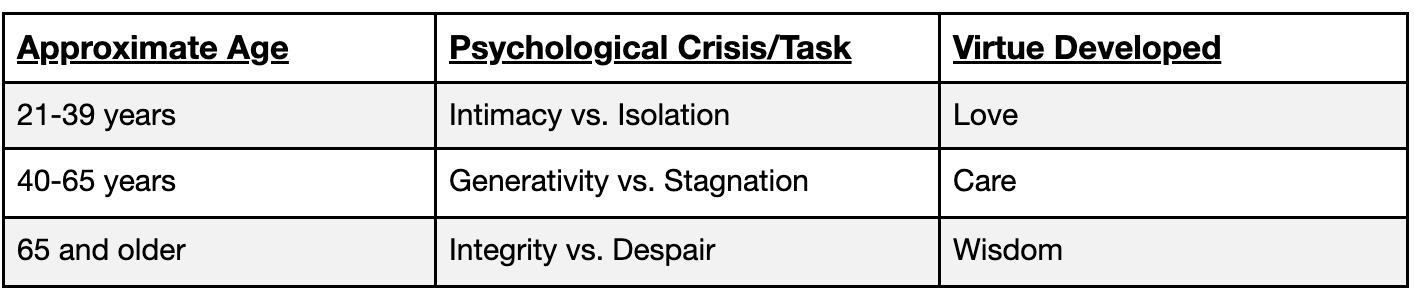
“Generativity,” a term coined by Erikson, involves “concern for others and the desire to contribute to future generations, often through parenting, mentoring, leadership roles, or creative output that adds value to society (McLeod, 2023).”
If you or a loved one is experiencing a shift in their inner life, understanding that development doesn’t end at the 21 can decrease feelings of judgement or worry, and help you embrace the changes of middle and later adult years.
Reference
McLeod, S. (2023, Oct 16) “Erik Erikson’s Stages Of Psychosocial Development” SimplyPsychology. https://www.simplypsychology.org/erik-erikson.html